Teachers! Are you interested in resources that can help you GLOBALIZE your classroom? Check out the following amazing programs and resources that you can implement in your classroom, today!
|

Globe Program
The Global Learning and Observations to Benefit the Environment (GLOBE) Program is an international science and education program that provides students and the public worldwide with the opportunity to participate in data collection and the scientific process, and contribute meaningfully to our understanding of the Earth system and global environment.
Vision: A worldwide community of students, teachers, scientists, and citizens working together to better understand, sustain, and improve Earth’s environment at local, regional, and global scales.
Mission: To promote the teaching and learning of science, enhance environmental literacy and stewardship, and promote scientific discovery.
UPFRONT: The New York Times Classroom Magazine
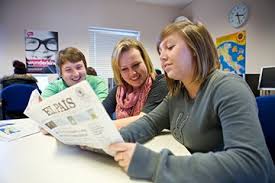
The New York Times Upfront classroom magazine helps educators integrate current events into the high school social studies curriculum. Discover compelling nonfiction reading, national and international news presented for a teen audience, a history feature that connects the past to today’s news, an expert debate that teaches persuasive writing, and a column on ethics.
SKYPE in the Classroom
This is an amazing online resource that allows you and your students to connect to the rest of the world. Perhaps you want to connect with educators and guest speakers from around the world to inspire your classroom. Or maybe you want to take your students on an adventure in your own classroom by taking one of several virtual field trips with Skype.
With SKYPE in the Classroom, you can do this–as well as access myriad other resources to begin globalizing your classroom. What are you waiting for? Check it out now! SKYPE in the Classroom
People to People International
The mission of People to People International is to enhance international understanding and friendship through educational, cultural, and humanitarian activities involving the exchange of ideas and experiences directly among peoples of different countries and diverse cultures.
- Travel
- Host visitors
- Connect with new cultures
- New and lasting friendships
- Learn about global issues from an inside perspective
- Apply for grants and scholarships
- Make a difference in the community
United States Institute of Peace
United States Institute of Peace works to prevent, mitigate, and resolve violent conflict around the world. USIP does this by engaging directly in conflict zones and by providing analysis, education, and resources to those working for peace. Created by Congress in 1984 as an independent, nonpartisan, federally funded organization, USIP’s more than 300 staff work at the Institute’s D.C. headquarters, and on the ground in the world’s most dangerous regions. This is a wonderful resource for secondary level social science educators that seek to globalize their classroom and get students to recognize perspective and take action.
Geographic Education
Grosvenor Teacher Fellow Program (GTF) is a professional development opportunity made possible by a partnership between National Geographic Education and Lindblad Expeditions. The program is named in honor of Gilbert M. Grosvenor (pronounced GROHV-nur), Chairman Emeritus National Geographic Society and Education Foundation Board. This opportunity is designed to give current K-12 classroom teachers and informal educators from the 50 U.S. states, Canada, the District of Columbia, and Puerto Rico the opportunity to extend Grosvenor’s legacy of excellence in geographic education. Through the program, exemplary educators are recognized for their commitment to geographic education and are given the opportunity to be actively engaged in finding new ways to bring geographic awareness to their classrooms or informal learning environments through a field-based experience.
Fund a Development Project
The NEA Foundation’s Learning & Leadership Grants underwrite teachers for a variety of professional enrichment experiences, from research projects to attending conferences and seminars. More than 60 grants were awarded in 2014. Past recipients’ projects have included a range of trips, from attending a grant-writing conference in Miami to 11 weeks in Mexico for intensive music and folk dance study. These experiences ultimately will pay dividends not just for the teachers but also for their students.
Join a Scientific Expedition
If donning waist-high neoprene waders and trekking through the Arctic wetlands of Manitoba taking water samples sounds like your idea of a cool summer vacation, try for a Teach Earth USA Fellowship from theEarthwatch Institute. Each year, the Institute sends about 50 teachers to join weeklong expeditions with world-renowned scientists working in the field to help collect samples and analyze them in the lab. The application deadline for 2015 trips—which will focus on studying the effects of climate change in the Arctic, Arizona and Ecuador—has passed, but teachers can request applications for summer 2016 expeditions.
Explore Another Country's Educational System
The highly competitive Fulbright Distinguished Awards in Teaching Program is a grant that allows U.S. and international teachers to go abroad for 3 to 6 months to learn about another country’s educational system. The Fulbright Distinguished Awards in Teaching Program recognizes and encourages excellence in teaching in the U.S. and abroad. U.S. and international teachers receive grants to study at a university, observe classes and complete a project pertaining to their field of educational inquiry during their time abroad. The program is open to teachers from the United States and selected countries in multiple world regions.
Germany Study Tour


Germany’s Goethe-Institut invites K-12 social studies teachers to explore modern Germany’s sights, sounds and tastes through its Germany Study Tours. Where do the best lessons in life come from? From Experience! Experience is what the Transatlantic Outreach Program is all about. Since 2002, TOP has sought to find the best and most qualified social studies educators and give them the opportunity to experience Modern Germany in the most dramatic way possible: in person. From Berlin to Frankfurt, from Stuttgart to Munich, from Hamburg to Kiel, from Dresden to Schwerin, and from Weimar to Leipzig, each corner of Germany is sampled through sight, sound, touch, and taste!
Japan-U.S. Teacher Exchange
The The Japan-U.S. Teacher Exchange Program for Education for Sustainable Development (ESD) provides U.S. teachers and administrators with a fully-funded opportunity to travel to Japan to learn about ESD efforts and strengthen ESD curricula in both countries. ESD is “a vision of education that seeks to balance human and economic well-being with cultural traditions and respect for the earth’s natural resources,” according to the United Nations Educational, Scientific, and Cultural Organization (UNESCO).
This website is not an official U.S. Department of State website. The views and information presented are the grantee’s own and do not represent the Teachers for Global Classrooms Program, IREX, or the U.S. Department of State.
 Traveling Fern